Translate

Showing posts with label Arctic Strike 2. Show all posts

Saturday, 20 October 2018

Arctic Strike 2018

Last weekend saw me travelling across the country to Grimsby for a game of Cold War Commander.  Our hosts, Grimsby Wargames Society were excellent, so a big thank you to Steve Graham, Andy Hamilton, Andy Bruce and Danny Malone.  The game, Arctic Stike, was organised by Richard Phillips, supported by umpires Richard Crawley and Steve Graham, so a big thank you to them, especially Richard P for his organizational genius.

The game was a continuation of a game played in 2013 at Dungworth near Sheffield, taking up a day or so in game time after the previous game.  Soviet motor rifle troops were advancing south from northern Norway, as well as making landings around Bodo and advancing east in an attempt to link up with the main thrust along the north-south axis.

This is the table for the thrust from Bodo, looking west, so Bodo itself is off the end of the table and the Soviets were to advance towards the camera.  There were a variety of beaches along the southern edge of this table (to left in photo below) along which amphibious troops could attempt landings.


A vital NATO resupply base/harbour on the southern table edge, with a freighter/transport loaded with Canadian reinforcements.  Richard Phillips (Fieldsway Scenics) did most of the terrain for the tables - an immense effort and really well done).


Slightly further west, showing potential landing beaches.  The river mouth shown would turn out to be a vital NATO stop line.  One of my terrain items is the lighthouse.


The main west-east highway with one of the NATO airfields in the far left.  This airfield was too close to the Soviet deployment zone and abandoned by NATO at an early stage.


The abandoned airfield.  Most of the airfield terrain was the work of Andy Miles.


The other airfield on this table was hotly contested in the end, but this was more in the NATO rear area.


Looking south from the second airfield towards the docks.


The main west-east highway at the NATO end of the table.  The small BUA and road bridge in the middle distance would be hotly contested.


The NATO forward deployment area.


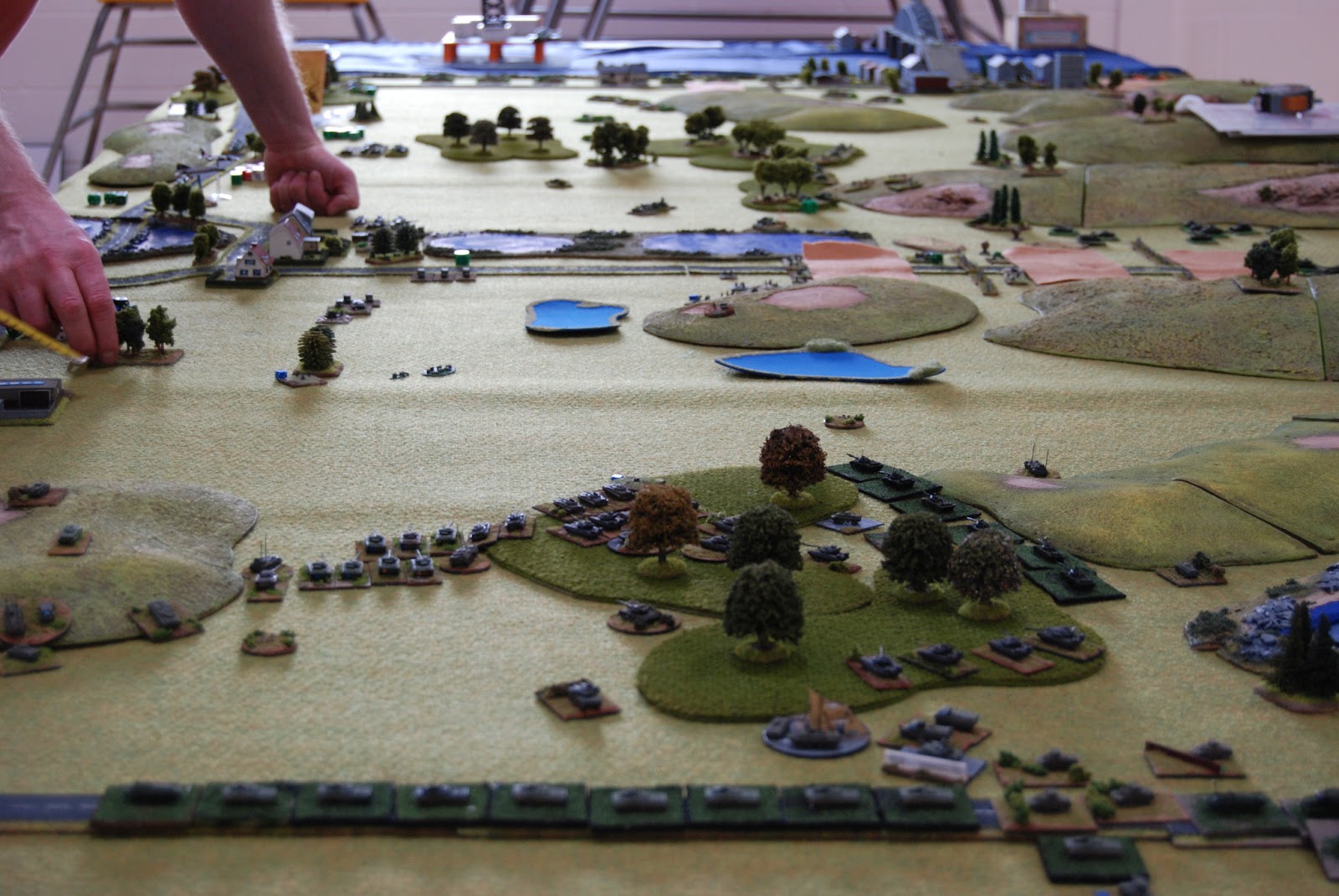
Then on the north-south table, this view looks north towards the Soviet table edge.  Again, amphibious capable beaches line the western (left hand) table edge.


Airfield in the NATO rear area, with runway by Richard P projecting out into the sea, based on a real world example in the area.


The NATO forward deployment area looking east towards Sweden and Finland.


View from the Soviet table edge looking south.


Pete Spencer's excellent helicopter armada, now part of Rodger's VDV forces.


Soviet air assets.


More Soviet air assets.


NATO air assets.


More NATO air assets.


Richard P's most excellent Aist LCACs.


I was NATO commander, which essentially involved me in allocating sectors to the mixed force pool available.  On the north-south table, I asked Rodger to hold the front line with his mottly collection of Norwegian regulars and home guard, while Mark's US high-tec infantry in dune buggies was tasked with holding the rear area, offering long range support to Rodger, but also securing the airfield and coastlines.  The big surprise on that table was to be a flank march by Simon's Finns, launching a spoiler attack into the Soviet eastern flank at an opportune moment.

On the west-east table, I asked Mark Julien, with his CAST battlegroup and Luxembourg contingent ("Luxy Boys" throughout the weekend) and Neil's 82nd Airborne to hold the front line.  I tasked Andy T's Royal Marine Commando Arctic Warfare contingent to provide rear area security for the airfield and to support Neil's 82nd if needed.  My USMC provided two marine infantry battalions to hold the dock area and secure the beaches, with a company of engineers at the rear river crossing and some TOWs to support Andy's RMCs at the airfield.

The plan seemed to work well on the north-south table, with Rodger's Norwegians putting up a stubborn resistance and Simon's Finns causing real trouble.  A landing by VDV in the NATO rear was badly scattered and finished off piecemeal by NATO.  On the second day, another VDV brigade group landing was more concentrated and made better progress against the powerful but brittle US High-tec infantry.  Sorry, but I don't have pictures for this table.

On the west-east table, the Soviet ground forces were slow to progress, due to poor command rolls and less than favourable terrain.  Two VDV brigade groups landed, one (Alan's) entirely by parachute, attempting to secure the bridge in the NATO rear area.  The other (Andy H's) landed partly by parachute to secure the airfield abandoned by NATO and the other to secure the airfield held by Andy.

Alan's VDV landing by the bridge were badly scattered and suppressed.  Andy's RMC battalion rear left by the hills were taken out by preplanned artillery strikes.  USMC infantry in the left foreground are largely facing the wrong way - towards the lower left beaches.  Thank goodness for the US engineers in the town, supported by an M728 combat engineering vehicle, and the TOW jeeps deployed in support of the RMC by the airfield.


At the same time, two brigades of naval infantry began landing troops.  Below, Andy B's vanguard launch into the Canadian flank, although terrain slows them down nicely.


Neil and Andy's troops take on Andy H's heliborne assault.
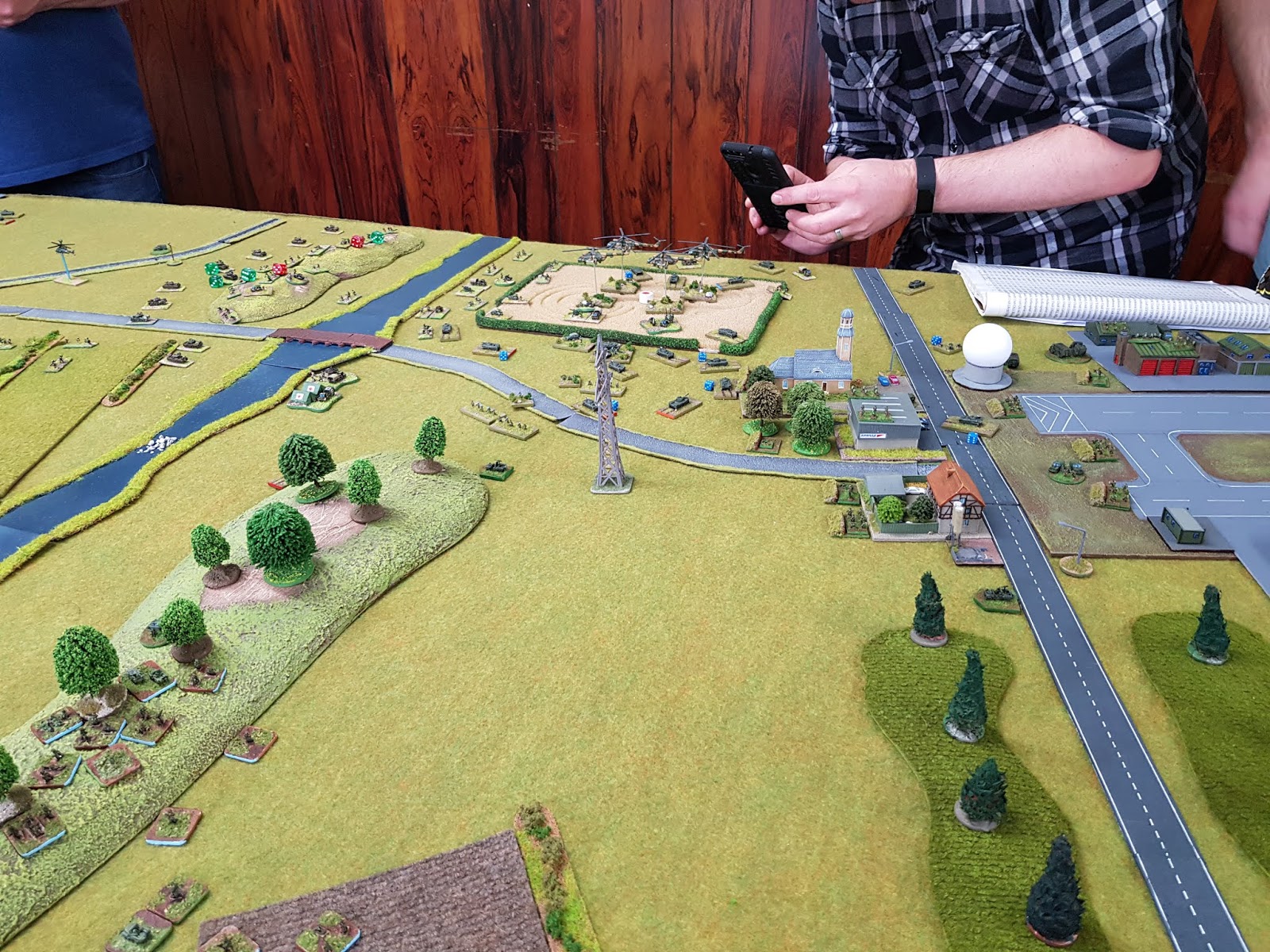

Oooh look, helicopters.


Andy H's VDV drop on the largely abandoned airfield.


Alan's VDV attempting to reorganize.  The VDV were so scattered they suffered either distance command penalties or command penalties for trying to command troops from other commands, which meant response times were poor.


Alan also took on a naval infantry brigade, which attempted to land near the docks.  Again, a thin strip of trees, but a real obstacle to the attacker.  USMC in the power station were locked and loaded, as were another battalion dub-in on a wooded ridge just out of shot to the right.


Alan's VDV still strung out and being thinned out, especially effective were Andy T's Lynx attack helicopters.


Soviet Naval Infantry and T-55s line the edge of the wooded beach top, waiting for the order to advance.


Around the docks, the Canadian Leo 1 company, held in reserve for the front line, does a great job of threatening the seaborne beachhead flank.


Andy B's Naval Infantry are still struggling to get off the beaches.


Alan's VDV around the town, still dispersed.  The USMC field hospital (lower right) was kept busy all day treating VDV paratroopers, initially lots of breaks and spinal injuries from the drop and later GSW and flash burns from exploding BMDs, together with a handful of USMC engineers.  Both sides seemed to respect the field hospital and it survived unscathed.


Alan's beach assault.  Infantry and APCs broke through the woods near the docks and attempted to get to grips with the troops in the power station, but USMC firepower is awesome, with a Dragon ATGW team, an HMG and at least a company of infantry with SMAWs stopping them in their tracks.  On the right flank, Dragon teams and SMAWs effectively dealt with a company strength group of T-55s that advanced into the fields on the right.


An artillery strike on the power station destroyed a lot of parked Bv206s and a TOW stationed in one of the buildings behind, but the bulk of the troops survived, albeit with lots of suppressions.


The situation at the end of day 1.  The Alan's VDV had eventually broken and he decided his Naval Infantry weren't going to break through so he reembarked them.


Day 2 saw a continuation of the struggle between Neil's 82nd and Andy H's VDV, augmented by some MRR troops that had caught up.  Andy B and Andy M continued their struggle with Mark's CAST battlegroup, although the Canadians and Luxy Boys suffered at the hands of a massive timed artillery concentration.  Meanwhile, the USMC launched an amphibious assault with armour and an infantry battalion on the beaches just vacated by Andy B.  This took some pressure off the CAST battlegroup as Andy B had to turn his forces around and Andy M had to divert forces as well, otherwise their flanks were too exposed.  Sadly, this kept me busy and I didn't get chance to take more photographs.

A great weekends gaming and a big thank you to all involved.  Looking forward to next time.  Oh, and the fish and chips were excellent!

Tuesday, 11 June 2013

The USMC assault Bodo - for a second time

At the end of May we managed to replay the USMC assault on Bodo, an attempt to try out the same scenario from the Arctic Strike megagame back in April.  Richard and Gordon generously let me have their force compositions, an airborne batallion and a sea transported infantry batallion with T55 battalion in reserve off table, together with a map of their set up.  Ian and I were able to put together enough of the right Warpact equipment to pass muster as the opposition.

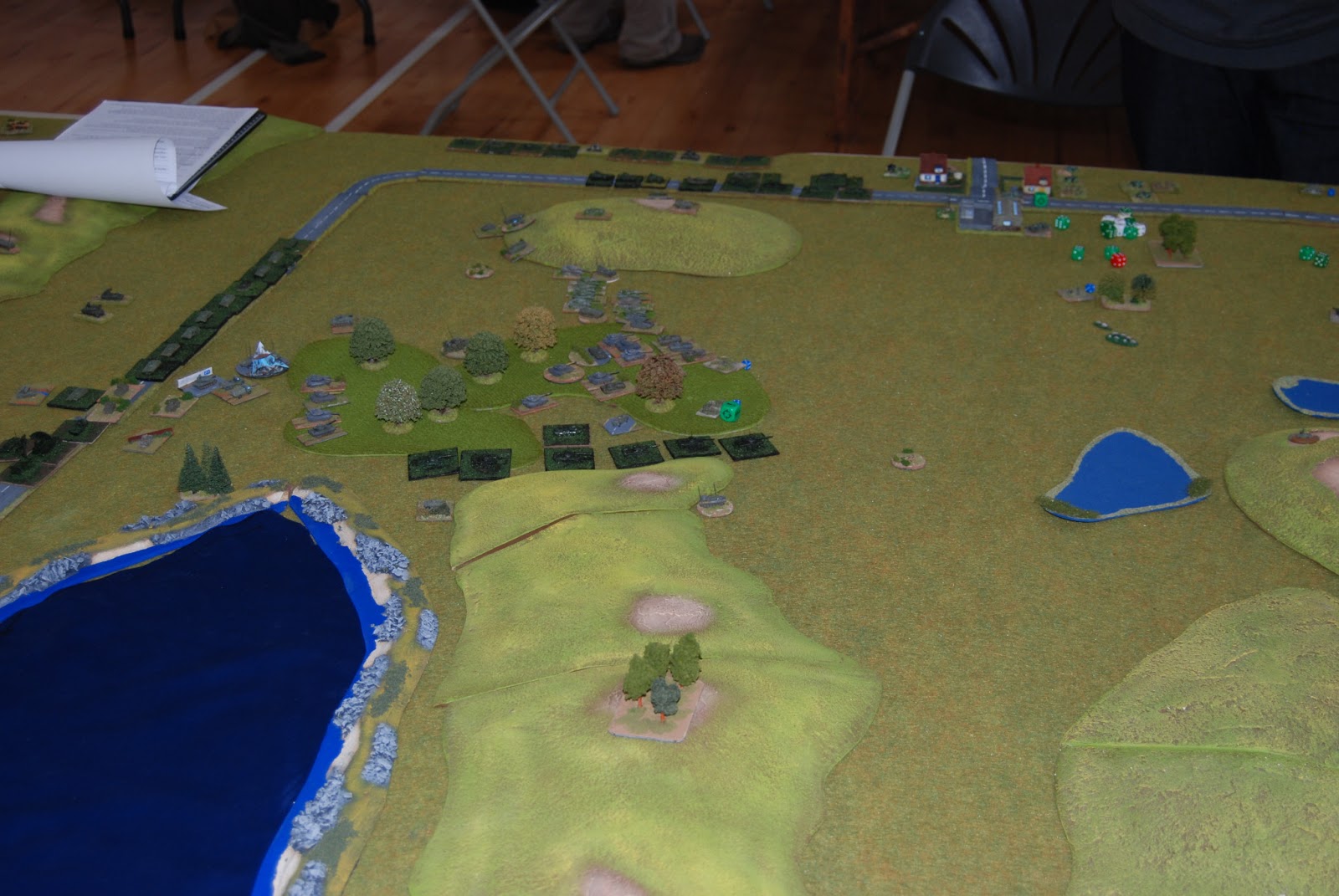
We set up the table using three 6x3ft folding tables with a blue cloth for the sea and carpet tiles for the terrain.  The photo shows the table as we laid it out, with Bodo to the right and the fjord coast at the top of the view.  The relief land forces would be coming from the east along the coast road (top left).  The coast itself is modelled as heavily wooded, offering soft cover.  All Warpact forces were dug in at the start of the game.

The crucial differences between this game and Arctic Strike was a) chemical weapons weren't available and b) pre-planned naval artillery was available to the USMC.  The AAR below is based on my memory of the key events - I didn't take any notes at the time, but seem to me to show the key features of the game - apologies if I've missed anything out.

The table layout looking south.
 
 And again.
 The layout looking west.
 The landing beaches looking north - landings took place between the wind turbine (the closest we could come to a lighthouse) and a WW2 fortification to the left of the view.
 Seacobras attacking advancing T55s.
 The USMC beachhead with M60s probing inland to meet oncoming T55s.
 And again.

This time I chose to land two infantry battalions and a reinforced M60 tank company across the beaches, keeping the third battalion in reserve to call in across the beach or by helo wherever the opportunity presented itself.  In the first turn, the Americans laid down a pre-planned smoke barrage delivered by two batteries of naval artillery and the infantry and tanks stormed ashore with negligible losses.  The Bronco transported FAC met with the same fate as at Arctic Strike, being brought down by manpack SAM fire (I'm going to have to keep their feet on the ground in future.  The Soviet response was to move artillery and air controllers to get a better view of the landings and to get the off board batallion of T55s heading south towards the threat from the coast.

In the second move, the USMC forces began to spread out laterally, assaulting or direct firing at dug in infantry around the WW2 fortification and wind turbine, while the armour continued to advance inland.  The Soviet response was largely to call in the salvo rocket artillery assets (all 10 batteries of them) and keep the T55s moving south.

By the third turn, the T55s were in sight and Seacobras were called in to attack, to assist the M60s in their line-of-sight slugging match with the T55s.  The TOWs of the Seacobras accounted for a T55 stand, but SAM fire revealed a number of Soviet units.  The M60s also began to take a toll of the T55s.  Dutch heavy artillery counterbattery fire began to whittle down the rocket artillery.  In the Soviet turn, two M60s were suppressed, but saving on a three was enough to ensure no losses.  Further rocket artillery strikes again whittled down some infantry, but not enough to be a problem.

In turn 4, Seacobras and M60s again whittled down the T55s, leaving only 3 stands by the end of the turn.  Naval gunfire support also began to inconvenience the Soviet SAMs and the adjacent dug in infantry and HQs.  The Soviets began to pull back some of the outlying forces, especially SP mortars, which blundered on the way back across the airstrip.

The last two turns of the evening saw the left flank USMC infantry batallion, less a company still engaged in mopping up Soviets in the WW2 fortification, advancing towards the hardened aircraft shelters.  On the right flank, infantry supported by LVTP-7s were attempting to mop up dug in engineers armed with flamethrowers on the right flank - tricky.  In the centre, the M60s dealt with the T55s.  The Soviet response started to cause losses to the infantry battalions.

So, in 6 turns the USMC had established a reasonably firm beachhead and still had an infantry battalion in reserve.  The Soviets had lost most of their T55s and a significant proportion of their artillery and SAM assets.  So, what were the main differences between the Arctic Strike version and the replay.  Well, the chemical attack on turn 1 at Arctic Strike eliminated a significant proportion of the infantry in the beaten zone and suppressed and degraded all of the M60s.  When subsequently hit by rockets (lots of them) the armour was knocked out (4 platoons worth) and infantry battalions were seriously degraded.  This time, the cover of smoke prevented rocket attacks in turn 1 - by turn 2 the infantry and armour had been able to spread out significantly.  Rick, the Soviet player, had responded as aggressively as he could with the forces available, much as Richard and Gordon did at Arctic Strike, but without the initial chemical attack and concentration of rockets,  the Soviet fire was not capable of seriously whittling down the attackers, particularly the M60s which are surprisingly tough.

All in all a fun game.  Thanks to Rick for proving an aggressive opponent and to Ian and Mick for umpiring and generally seeing to fair play, as well as providing all manner of period flavour.

Monday, 15 April 2013

Crisis Point 2 Arctic Strike 2013 - AAR

Well, after months of preparation, Arctic Strike raced by in the twinkle of an eye.  I arrived later than planned, due to some heavy Friday afternoon traffic, the fact that Dungworth appears to lie within the South Yorkshire triangle and the local council had decided to close several local routes for repair.  After a great evening of beer and chat in "The Royal", it was down to the village hall on the Saturday morning to finish setting up and organise our command groups.

From the pre-battle maps and scenario documents, I was expecting my USMC 4th Marine Amphibious Brigade to be pitted against either or both Soviet paratroops and Naval infantry around Bjerkvik on the middle table.  During the pre-game briefing, that quickly changed and I found my marines being tasked with retaking Bodo from what appeared to be a paratrooper and a naval brigade, including at least 10 batteries of salvo rocket launchers.  A follow-up force on Sunday included motor rifle and tank battalions.  Fortunately, the British armoured regiment and a Dutch mechanised battlegroup were also assigned to the table, coming on from the eastern end and pushing west for Bodo.  My marines would be able to land amphibiously anywhere along the southern table edge.  The key terrain feature in the mid-part of the table was a bridge on the main road, close to the coast, which crossed a north south flowing river that cut the table in two.

The first couple of turns saw my marines floating offshore waiting for something to happen.  Having air superiority on turn 2 and some nice marine corps air assets available, I tried to bring on a Bronco FAC spotter, only to see him brought down by SA-7s firing out of the Bodo Lidl store. The Brits made enough progress in the first 2 turns to see their advance group of armour and mechanised infantry advance onto the bridge half way across the table, but their advance was slowed by a skirmish line of Spetsnaz infantry, backed up by salvo rocket barrages.  This was the time, I thought, to bring on the USMC to help take some of the heat off the Brits at the bridge and help them and the Dutch break through towards the eastern end of Bodo, thus allowing the marines to occupy Bodo airport and mop up the Soviet rear areas.

Alas, it was not to be.  My marines landed on turn 3 in relatively good order on the beaches between the lighthouse and the old WW2 German fortifications.  The scouts moved inland, one revealing a hidden minefield which split the bridgehead into two parts.  Two infantry battalions landed in LVTP-7s and one on foot, with a reinforced M60 company in support.  Unfortunately, there was no artillery support available - the Dutch were throwing their lighter artillery at the Spetsnaz around the bridge and the heavy stuff was shelling the Soviet paras around Bjerkvik.  My marine air wing had already been added to the general NATO air pool, so there was no integral air support, except the Sea Cobras, and NATO air assets were giving support in the Tromso area, rather than further south.  Net result, no smoke, no bombardments, no air support.  The marines ran into a whole bunch of trouble.  Initial op fire from BMD mounted Spigots and infantry was bad enough, but at least that provided some targets, with the M60s taking care of several BMDs and three Sea Cobras, reduced to two after one was forced to abort, taking out or suppressing some other paratroop infantry.

Unfortunately, in the Soviet turn 3, an air strike delivered a persistent nerve agent/irritant chemical attack, which effectively neutralised the bulk of the M60 company and a whole bunch of infantry on foot and in LVTPs.  Then came the salvo rocket artillery - 10 batteries worth on my tightly concentrated USMC beachhead.  Although deviation was quite large, the larger beaten area, coupled with the sheer number of tubes, was devastating.  By the end of turn 3 (all the turns we managed to cram in on Saturday), the marines had reached breakpoint.

Saturday evening saw a worn out bunch of wargamers eating excellent pies (steak and oyster in my case) and drinking good Yorkshire Ales.

The next day, I struck lucky in returning infantry from the front line aid stations (30% infantry) and armour from the repair shops (50% armour including two of the gassed M60s).  My elation was short lived.  The infantry managed to get off some shots at the infantry either side of the beachhead, but most of the armour was still supressed.  Any chance of artillery support disappeared when the Dutch artillery blundered off the rear edge of the table with no opportunity to return for 2 turns.  Then, in the Soviet turn, in came the salvo rocket artillery, plus a whole bunch of other artillery - not to metioned the advance of at least one battalion of improved T55s.  Attrition on the USMC forces was horrendous.  By the end of turn 4, my forces were reduced to a breakpoint modifier so low that it was impossible for the surviving CV9 HQ to pass a break test and my battle group broke.  I like to think those at the beach made it out on LVTPs and LCACs, but suspect a lot had to surrender - hopefully, their sacrifice earned them some decent treatment from the Soviets.

So, what was the experience like.  I suspect I know how a WW1 general must have felt.  I had spent the previous 8 months buying, painting and basing the USMC force, the last 4 months including various practice games with Ian and solo, trying to hone my skills as the battlegroup commander.  I then found myself throwing them at some pretty impressive soviet assets, including regular and paratrooper infantry, armour and massive amounts of artillery backed up by anti-air artillery.  They did well to last 2 turns!  So, 8 months in the making, 90 minutes in the breaking - an experience more like the Somme or Paschendaele.

Setting that aside, it was great to play a part in such a large game.  Our games so often take place in isolation as a single club evening game, so it was really good to see how the performance of each battle group effected the final outcome on each table.  The tables themselves looked excellent - I felt really privileged to play on such high quality terrain, and against forces that had been so meticulously researched and painted up to such a high standard.  It was also a great opportunity to meet and chat with wargames gliterati from all over the U.K. over a few beers.

My suggestions for improving the experience would probably echo others;

In general
  • better pre-game planning - detailed maps and pre-allocation of forces to allow pre-planned artillery fire programmes and air attacks.
  • team briefings carried out before the event so players know the situation on the table and what is expected of them
  • as early a start as possible, with a 10-15 minute briefing ahead of kicking off the first turn.
  • breaking larger tables into smaller sectors or fronts managed by a single player on each side - at times dring the game I was playing for considerable amounts of time against two soviet players, while two other NATO players were waiting to get on at their end of the table.
USMC specific
  • next time they go in to action, my Marine Air Wing will need to be prised from my cold dead hands
  • next time they go into action, my marines will have full naval fire support, including at least one Iowa class battleship firing preplanned barrages on map targets
  • next time they go into action, if the Dutch (no offence to any real citizens of the Netherlands living or dead) swan around touring the countryside, they'll find themselves the targets of the air wing, if not a couple of tac nukes.
  • next time I'll have the full M60 battalion with me.
  • large scale D-day type landings are a thing of the past, especially if contested.  Marines are best off seizing objectives by coup de main and then holding them.
The Future
Looking forward to Ian's Stalingrad game at Gauntlet.  Also interested in looking at any follow up games for Arctic Strike and for a 6mm megagame in Chester in 2014 (name and period still to be confirmed), plus the possibility of a 20mm modern game, Crisis Point 3, at Dungworth next year.  Just need to know what forces I'm doing and start the next arms race.

Bodo table looking west
 Bjerkvik table looking north
 Tromso table looking east
 The Bodo coastline looking west.  The choke point bridge inthe right foreground and USMC landing beaches beyond lighthouse
 Oil drilling platform off Tromso
 Tromso, scene of a gallant resistance by Nick's Norwegian forces
 Hamlet on Bjerkvik table
 Bjerkvik
 Bodo airport
 Downtown Bodo
 The bridge choke point on the Bodo table
 The chemical cloud - all that remains to make the destruction of the USMC brigade.
 The E6 heading north towards Narvik and Bjerkvik (thanks Richard)
 Bodo looking east
 The choke point bridge outside Bodo
 Soviet perimeter of Bjerkvik
 Tromso bridge (actually Baggage Train Arnhem Bridge - a nice model)
 Bjerkvik from north
 Oil platform with Soviet disguised helicopter on pad
 Tromso
 Tromso bridge
 View looking south on Tromso table - vital road junction by red roofed buildings top right.
 The vital junction south (to left) on the Tromso table, contested by Jamie's Finns to the end of day 2.
 Airstrikes on the road from Murmansk.
 View west on the Tromso table near the end of day 2