Translate

Showing posts with label Gettysburg. Show all posts

Thursday, 7 July 2016

Gettysburg; Picketts Charge in 10mm

For the second day at Gauntlet, Will and I were debating whether to carry on with the Korsun Pocket game or try an ACW scenario from the new Glory Hallelujah! Black Powder book, which Will has recently acquired.  On hearing this, Steve mentioned he had a 10mm ACW collection with 30+ regiments per side.  This was too good an opportunity for Will to organise a refight of the Gettysburg - It can't be long now scenario.  Terrain was a simple ridge along one long table edge, lined by Union infantry and artillery, with the Rebs arrayed up to 1ft on from the opposite table edge.  For the Union, Gary took the let wing with II (part) and III corps, Jamie the centre with II corps 2nd Division and I corps 3rd Division, and Richard the right wing II corps 3rd Division and I corps 2nd Division in reserve.  Opposite them on the Rebel right was Steve with Pickett's Division and on the left was me with Pettigrew's Division with Gary and Trimble's Division behind me.

So, it's July 3rd 1863.  After 2 days of heavy fighting around the Pennsylvanian town of Gettysburg, the armies of the Union and Confederacy face off against each other, the Union occupying Cemetery Ridge and the Confederacy occupying Seminary Ridge.  Lee appears to have reached a decision and ordered Pickett, Pettigrew and Trimble to assault the Union lines.  The scenario starts with the Rebs approaching the Emmitsburg Road and about to have a very bad day.


Trimble's Division in the foreground with Pettigrew's Division beyond.


Pickett's Division nearest the camera.


The Union defence in depth on the ridge.


Looking from Cemetery Ridge towards the Emmitsburg Road.


The first turn sees Pettigrew get all 3 of his brigades moving forwards, while Trimble gets one brigade to advance, the other deciding to wait a bit to see what happens.


On the right, Pickett's men are positively jogging.  However, rather than focussing on the same point in the Union lines as Trimble and Pettigrew, they are veering off towards the Union left wing.


The view at ground level.


Pettigrew's troops with Pickett charging in the distance.


Pettigrew starts to shake his columns out into 2 regiment deep lines ready to charge home on the Union lines.


Pickett continues to advance, but not quickly enough.


Pickett is now within charging distance of the Union line.


Pickett's other brigade picks up the pace.


Pettigrew stalls momentarily.


Trimble gets a rush of blood and moves up on Pettigrew's flank.


One of Pettigrew's brigades seems to have developed a death wish.  Union commanders look on expectantly.


Lunchtime, and I had to take some photos of the excellent Team Yankee game organised by Dennis and Pete.  The crashed cars in the town centre look great.


Love the American SPG models.


Apache gunships move in on a company of T-72s.


After lunch, back to Gettysburg.  Pettigrew's Division charges the Union line.  Despite withering closing fire, they manage to wipe out 2 Union batteries and melees embroil the length of 6 regiments.


The view from the ground.


Trimble's brigades move up and the foremost brigade gets within musket range of the Union flank.


Ongoing melees sap the strength of attackers and defenders.


Confederate ranks are thinning faster than the Union at Pickett's end of the table.


Union numbers on their left flank told in  the final analysis and 2 of Pickett's Brigades broke and fled the battle.  We played out another turn at Pettigrew's and Trimble's end of the table as there were a number of ongoing melees, which were often going the Reb way, although fresh reserves were being fed along the line, so it was only a matter of time.  Trimble's Division was able to retire largely unharmed, while Pettigrew's Division was badly mauled and Pickett was down to one effective brigade.  I think this is one of those scenarios where the Rebs can only win by not turning up.  The High Water Mark of the Confederacy was a little further north of the actual historical spot, but about the same distance in, which suggested an honourable draw, albeit a very bloody one for the Rebs.

Thanks to Steve for providing the troops and terrain and for Will for organising the scenario with very little lead time.  Thanks also to Gary, Jamie, Richard C, Steve and Gary for providing a fun game with the right level of commitment to the scenario tasks, the history of the period and, above all, having fun with toy soldier.

Thanks for looking.

Friday, 18 October 2013

First tabletop outing for the 6mm ACW project

Last night at the club Rick and I gave our 6mm ACW armies an outing.  Rick had 5 regiments of infantry and 2 artillery batteries ready, to which we added the 4 regiments of Zouaves from my collection.  That left me with 12 regiments of infantry and 4 artillery pieces.  Rick suggested I come up with a scenario, so I scouted out the free stuff on the Fire and Fury and GHQ web sites and took a look through the Gettysburg scenarios in the recent Wargames Soldiers and Strategy magazine.  In the end I came up with the "Assault on the Iron Brigade" scenario from the GHQ site, supported by additional information from the WSS magazine.  As we were using Black Powder, I pinched a trick from Will at the club and totalled the number of troops present and divided by 400 to get similar sized units.  Surprisingly, this gave the Union and Confederates the same number of troops, 2 brigades of 4 regiments each, with the Union having one additional regiment in reserve, coming onto the table on move 6.  The Rebs got 4 stands of artillery, while the federals only got 2 stands.  Each brigade commander, Meredith and Cutler for the federals and Archer and Davis for the rebs, were rated a leader 8, as was Pegrum the reb artillery commander, while the divisional commanders Wadsworth and Heth were rated as 9.  The game started as the rebs advanced out of the scrub and wheat fields lining Willoughby Run, either side of the Chambersberg Pike.

The initial positions of the troops viewed from the south - McPherson's Ridge on the right, with Meredith's Brigade in column behind and Archer's Brigade astride Willoughby Run..
 View again from the south showing one of Cutlers Regiments around the McPherson Farm, with the federal artillery between the road and railway cut, and the rest of Cutlers Brigade beyond, facing Davis's Brigade which starts on the federal side of the Run.
 Meredith's Brigade on the reverse slope of McPherson's Ridge keeping out of sight of the rebel artillery.
 The situation at the end of turn 2, in the foreground Archer has lost a regiment, while another has fallen back across the Run.  In the middle ground, one of Davis's regiments has routed the federal artillery, while the rest of the brigade have charged home into Cutlers advance regiment on the ridge.
 Davis's brigade with Heth charging up McPherson's Ridge.
 Archer's Brigade hard pressed by Meredith.

 Archer stabilises the situation with the assistance of the rebel 4 stand battery.
 Cutlers advance regiment has broken
 Davis's lone regiment south of the railway cut advances on Cutler's lone regiment around McPherson's Farm.

And I'm afraid that's where my picture taking stopped.  Cutler's regiments on McPherson's ridge charged into Davis's brigade, but were repulsed shaken while their lone regiments south of the cut traded volleys, each becoming shaken.  Meanwhile, the rebel artillery and Archer's surviving regiments were able to shake all of Meredith's Brigade.  This meant that both Union Brigades were broken by turn 5, resulting in them retiring from the field.  The confederates were, themselves, almost bled dry, with each brigade represented by a single viable regiment, all others being shaken.  To follow up the federal retreat would require reinforcement and Archer and Davis would need to spend considerable time rallying their Brigades to get them fit enough to carry on the fray.

All in all a fun game and the figures looked the business.  We completed the scenario in c. 90 minutes, so I lent my rebs to Red and we played out the scenario again.  Rick tried some innovative march moves, one which worked, to move some of Meredith's brigade around behind McPherson's Farm, and the other which didn't, to reinforce at McPherson's Farm with Cutler's brigade - they were hard pounded by the rebel artillery and charged, still in march formation, by Archer's troops.  So, another Reb win, but again a close run thing.

All in all, I felt the game played well and will certainly be adding more forces so that we can lay out some larger and more challenging games in the future.  I am even considering a venture into Naps at this scale sometime in the future.

Thanks for looking.

Sunday, 23 June 2013

ACW Black Powder - Gettysburg Blocher's Knoll scenario

A couple of weeks back Will and I played out a Gettysburg scenario using Black Powder.  As ever, when playing Will, the scale used was 20mm and the figures mainly plastics from his extensive and comprehensive collection.  He had selected a scenario from "Wargames Soldiers and Strategy" Issue 66 by Mike Evans and Don Effinger entitled "The destruction of 11th Corps".  This scenario involves quite substantial forces on both sides and recreates the fight for Blocher's Knoll, now known as Barlow's Knoll, a site I had the privilige of visiting back in May.  The federal player gets 5 brigades, four deployed on table and one in reserve arriving on turn 3 (the reserve brigade historically never made it but the scenario allows it to deploy as a "what if").  The confederates get 4 brigades, all on table at the start.  The scenery is dominated by a north-south wooded brook, Rock Creek, to the east with a knoll (Blocher's Knoll) offering a good artillery platform (except for a strip of dead ground around the knoll where artillery cannot depress sufficiently to cover) just to the right of centre.  One confederate brigade (Doll's from 3rd Division) and artillery battery are deployed in line to the north, while the other three brigades (from Early's 1st Division; Gordon's, Hay's and Avery's) plus artillery batteries come down in column along a road east of the brook, which crosses via a bridge and contines south past the knoll.  Rock Creek is a minor obstacle to infantry with stands required to halt at the banks, cross on the next successful order and advance beyond on the third order.  Artillery can only cross at marked bridges.  The federal troops deploy in line with, from west to east, Schimmelpfennig's, Krzyzanowski's, von Gilsa's and Ames' Brigades.  Schimmelpfennig's Brigade had deployed two regiments (45th New York and 61st Ohio) as skirmishers in front of the federal line west of Blocher's Knoll.  Federal artillery were concentrated in Blocher's Knoll.  Most federal leaders were rated 7 while the reb leaders were 8's with a couple of 9's.  Black Powder rules were used largely as written except that we changed the firing so that opponents fire after active player moves, to prevent an advance to close range and delivery of a devastating volley without receiving fire.

The confederates pushed Gordon's Brigade across Rock Creek under cover of an artillery battery, while Hay's Brigade moved down the eastern bank of the brook along with another artillery battery.  On the reb right flank, normal range artillery fire began to take a toll on the 45th New York skirmishers.  The federal response was to concentrate fire from von Gilsa's and Ames' Brigades and artillery on the east side of Blocher's Knoll onto the lead regiments of Gordon's Brigade.  The federals then moved Ames's Brigade forward.  In response, reb fire was limited in effect, although Gordon's front regiments assisted by artillery support began to hit home on von Gilsa's Brigade.

Next turn, Gordon's follow-up regiments advanced to the front while Gordon and Early attempted to rally the original flont line regiments.  Hay's Brigade continued down the left flank reaching a point opposite Ames' flank, as did the accompanying artillery.  Avery's Brigade followed up to the bridge.  Firing was particularly bloody between Gordon's and von Gilsa's brigades, while long distance artillery fire from the western side of Blochers Knoll and the west flank of the rebel lines again took a toll of Dole's Brigade and the 45th New York in particular.

In the next rebs turn, Hay's Brigade forded Rock Creek and formed a line facing the flank of Ames' and von Gilsa's Brigades.  Ames' Brigade swung to face the new threat, but close range volleys took their toll.  Gordon's Brigade was pretty much spent, but so too was von Gilsa's.  Avery took this opportunity to blunder and headed back up the road away from the action.  Over on the reb right flank Dole's Brigade and the supporting artillery broke the 45th New York.  At this point Costers Brigade began to appear behind Ames' Brigade, although attached artillery blundered, delaying them for two turns.  Unfortunately, next turn these came under effecitve fire from Hay's Brigade, albeit doing damage themselves in return.

In turn 5,  Hay's and Gordon's Brigades pretty much spent themselves, although at the expense of breaking Ames' and von Gilsa's Brigades and effectively neutralising most of the reinforcing Brigade of Coster.  Over on the rebel right flank, artillery exchanges did for one of Doll's regiments and one of Schimmelpfennig's leaving honours even.

By the start of turn 6, where we had run out of time, the rebels had broken Ames' and von Gilsa's Brigades, leaving just one effective regiment in each brigade.   Schimmelpfennig's Brigade over on the federal left flank had lost 2 of 5 regiments, while Krzyzanowski's Brigade was effectively unengaged throughout so remained at full strength.  Although not broken, both Gordon's and Hay's Brigades were no longer effective, but Avery's Brigade had made their way back to the bridge and were in the position to flood across and assault the federal artillery on Blochers Knoll with support from a number of rebel artillery pieces.  We therefore agreed that the confederates would have been able to force the three union right flank brigades to flee the field, probably then allowing them to mop up the two remaining federal brigades from the flank while pinned to their front by Dole's Brigade.  Although the rebels hadn't lost 50% of their infantry at the time we had to finish, we suspected they would reach that level, so, according to the scenario victory conditions it would be classed as a draw.

The difference between the rematch and a historical outcome seems to have been the arrival of Coster's Brigade to bolster up the federal lines.  In reality, Coster was ordered forward in support far too late in the day to do more than to fall back with the routing 11th Corps into the outskirts of Gettysburg.  In the rematch, at the point where they appeared Gordon's and Hay's Brigades had pretty much defeated Ames and von Gilsa.  Without Coster, the rebs would have been free to sweep around Blochers Knoll and attack along the flanks of the federal line, pretty much the historical outcome.  Instead, they traded fire with Hays, degrading them at their own expense, but effectively neutralising the threat on the left flank until Avery's Brigade was able to come up.  All in all a really fun scenario, played in a great spirit, Will kept smiling despite my glee at watching yet another federal regiment failing it's morale and fleeing the field.  If this is an indicator of the fun in playing the other scenarios in the issue, we'll be in for a good time.  There is even an option to amalgamate all the scenarios into a large scale refight of the whole of the first day at Gettysburg on a giant L-shaped layout.  Something to think about with at least three players per side and a club games weekend to give enough time.

Aplogies but no camera, so no piccies.  I will definitely have to remember it for the next scenario as over 20 regiments per side, each made up of four stands of four 20mm figures, makes an eye catching spectacle.

Some photos of the real terrain from previous posts.

Barlow's statue on Blocher's/Barlow's Knoll.  The trees behind line Rock Creek.
 Federal artillery positions on top of Blocher's Knoll with Rock Creek in the trees behind.
 Looking more or less due north from Blocher's Knoll into the dead ground where artillery couldn't depress the guns sufficiently.

Thanks for looking.

Saturday, 8 June 2013

Gettysburg Battlefield 2013 - 150th Anniversary part 6 the Angle, Copse of Trees and the Highwater Mark of the Confederacy

Time was getting short and it was almost beer O'clock by the time we finished at the Peach Orchard, so we drove along Plum Run but didn't stop there, before heading on to the Pennsylvania Monument where we decided to miss out Spanglers Spring and Culps Hill before heading on to the Angle.

 This is the Pennsylvania Memorial, a very imposing structure.
 And again.
  Statues of Meade and Lincoln.
 Lady in period dress (on the left - don't think dayglo had been invented in 1863).
 The Pennsylvania Memorial, if I remember correctly it records the names of all Pennsylvania citizens who fought in the battle.
 A Minnesota Regt memorial on the union lines in front of the Pennsylvania Memorial.
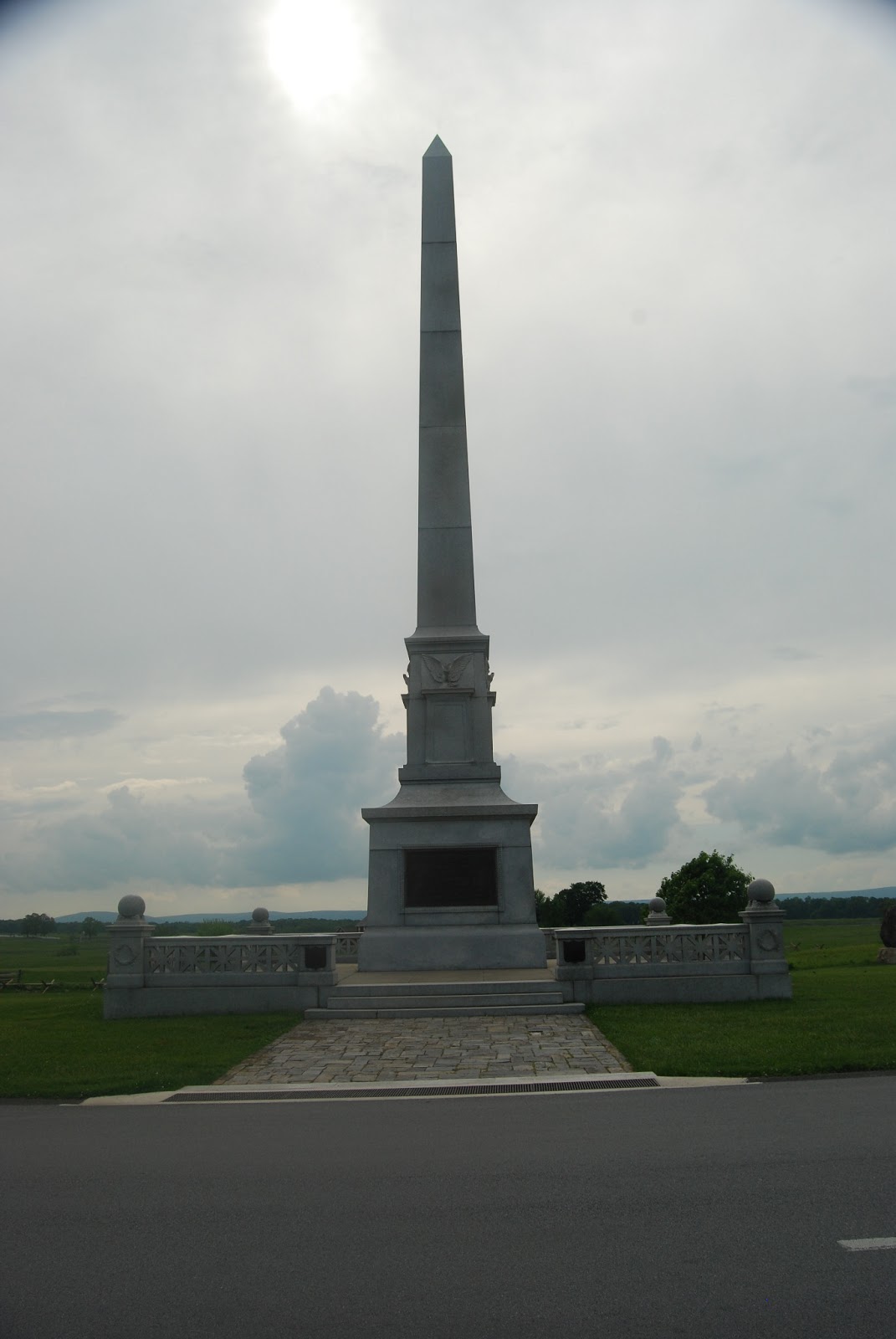
 Monuments marking the union line on Cemetary Ridge.
 Can't remember what this one commemorates but it's on the union lines.
 Looking south along the union lines on Cemetary Ridge, the Pennsylvania Memorial in the distance.
 Looking north along the union lines, the Copse of Trees is on the right.
 A panoramic view looking west from Cemetary Ridge, the trees in the distance are those on Seminary Ridge that covered the initial forming up of the confederate assault forces for Picket's charge.  Note the undulations in the ground that at least provided some respite from grazing fire, but not much.  The Codori Farm is visible in the middle of the picture and the Appalachian Mountains can be seen in the far distance.

 The Army of the Potomac Memorial. 
 The Copse of Trees, looking north.  The union lines were facing to the left, on the left hand edge of this photograph.  The confederate troops that made it to the union lines crossed the low stone wall, only to find that three union regiments had wheeled back to fire enfilade into their flanks.  The union regimental positions are marked by the three posts with rectangular plaques in front of the trees.
 The Copse of Trees looking south.  Survivors of the charge that made it across the wall were faced with three union regiments in line, volley firing towards the camera.
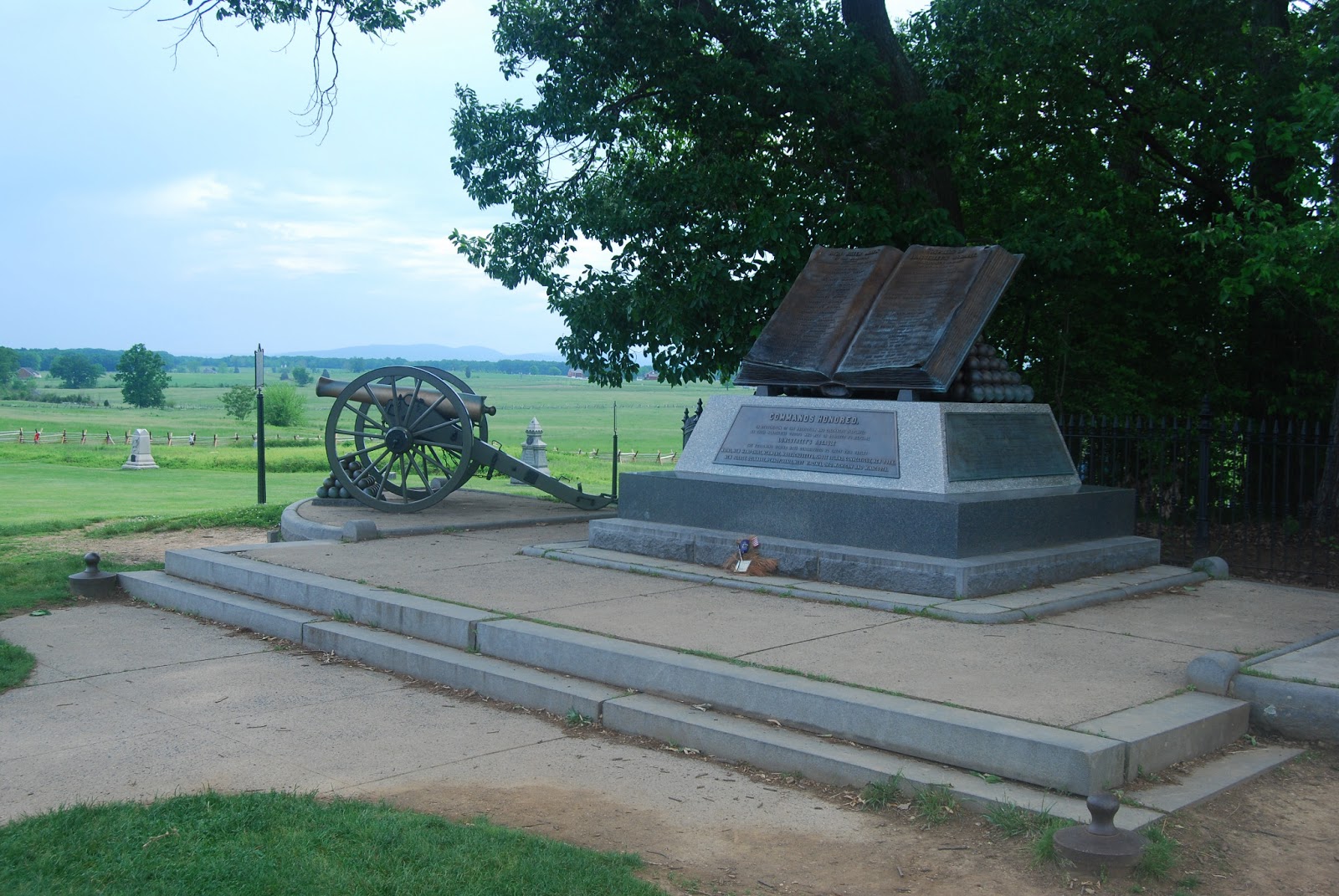
 The Highwater Mark of the confederacy.
 And again.
 And once more.
 Union battery positions and the union artillery park.
 The memorial marking the approximate position of Armistead's mortal wounding.  His fall took the heart out of the remaining confederate troops who fell back, effectively ending the battle.
 Looking west, the Angle is an almost right hand turn to the left in front of the memorial by the tree.
 71st Pennsylvanian infantry memorial at the Angle.
 Looking south from the Angle.
 Memorial to a Zouave Regt, close to the Copse of Trees.
 The Highwater Mark again.
 The line of union memorials behind the Copse of Trees.
 An unusual motif for a New York unit, with a North American indian and a wigwam.  This is the memorial to the 42nd New York infantry.

We finished up with a visit to the Soldiers Cemetry.  This is the memorial close to the site of Lincoln's Gettysburg Address, delivered at the inauguration of the Soldiers Cemetary.
 The Soldier's National Monument.
 Not much of a headstone, but better than the "unknown" next to him.  Considering many of the dead were left on the ground or in shallow graves for the best part of a year after, it's better than nothing, but contrasts with the grand monuments elsewhere onthe battlefield.

Quite a lot of them though.

So, that's where we ended our tour.  The Appalachian Brewery bar and restaurant on the outskirts of Gettysburg was calling.  On  the whole well worth seeing if the chance ever presents itself.  150 years ago this July 1st, 2nd and 3rd.

Thanks for looking.