Translate

Showing posts with label Castle. Show all posts

Thursday, 15 August 2019

Llanstephan Castle, South Wales

Another family holiday to Carmarthen saw us staying just outside Llanstephan, close to a lovely beach and this excellent Medieval castle.  There is an excellent free car park by the beach, but that leaves a really steep climb up lanes and eventually a stony footpath to get to the castle.  Although not too strenuous, it's a bit of a climb for the elderly or infirm, or those with really young children.

The new gateway, added in Tudor times, the main gate, originally to the right, was blocked to turn the old gatehouse into a high status residence. 


The outer walls are surrounded by steep slopes dipping seaward, covered in dense woodland, which hides the banks and ditches of an Iron Age promontory fort, which the castle is built within.


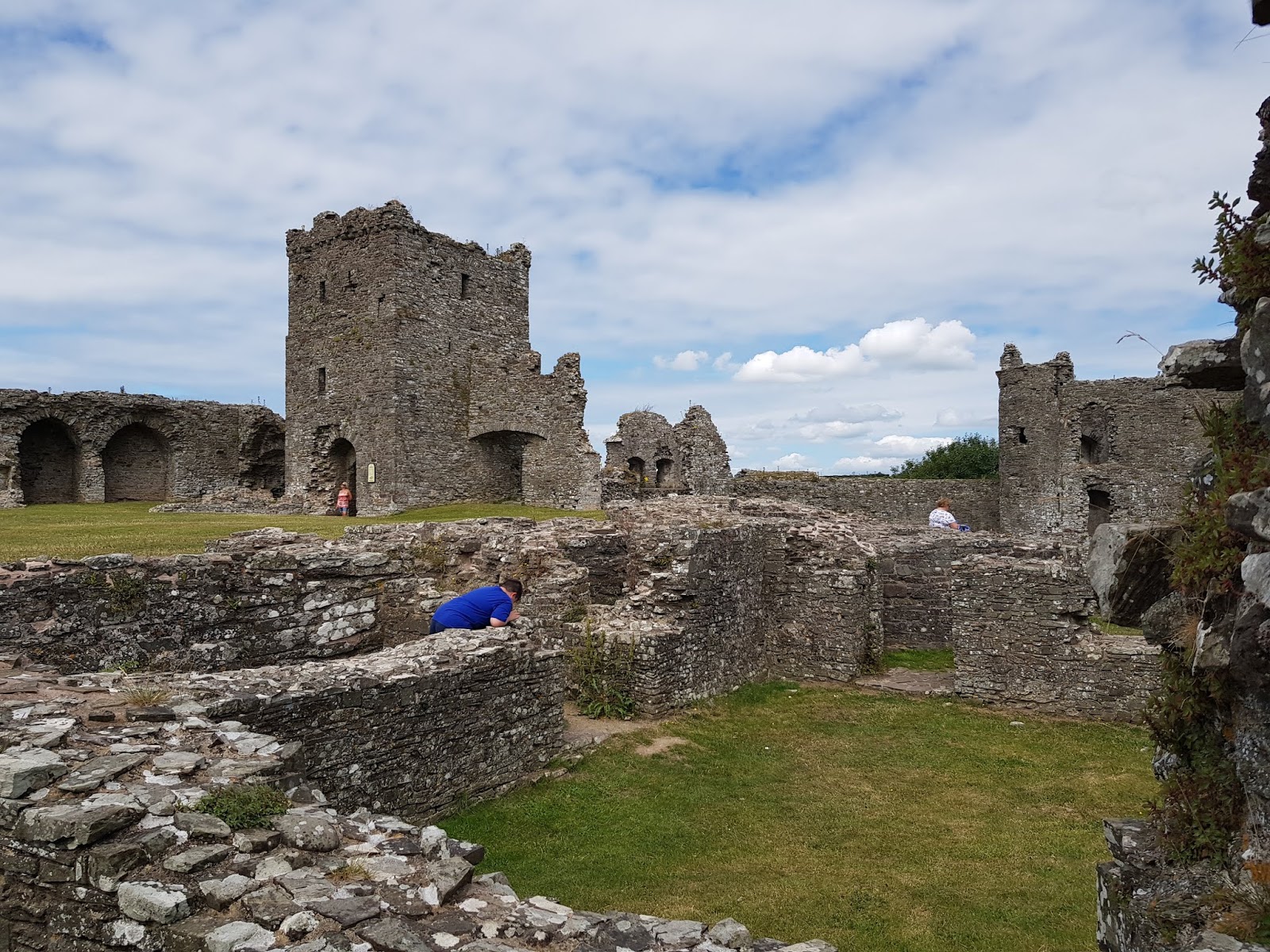
Within the inner ward, the large building on the left is the gateway between the outer and inner wards, but the inner ward wall has been demolished, probably during Tudor remodelling.


The view from the well at the highest point within the inner ward, looking out into the Bristol channel.  The hills in the distance are on the Gower peninsula, separated from the headland in the foreground by the Loughor estuary.  Llansteffan castle lies at the opening of the Towy estuary, close to where it merges with the Laugharne estuary, so sits in the heart of sea transport routes in the area, while lying on a rather isolated peninsula from the landward side.


The inner ward gatehouse on the left with the main gatehouse to the right in the distance - note the big difference in elevation between the much higher inner ward, compared to the outer.


Remnants of buildings within the inner ward.


The inner ward gatehouse.


View inland from the top of the old gatehouse - just about the only structure that could be entered.


The old gatehouse from outside - quite impressive ramparts.


The blocked up gateway from the main gatehouse.  Floor level of the doorway would have been above head height, presumably entered via a wooden ramp or drawbridge across to a wooden ramp and platform.


Not a bad little castle, free to visit and well worth 1-2 hours, depending on walking pace and level of interest in the ruins.  The link below is to the wiki page for the castle, which isn't comprehensive, but does suggest it was the scene of military activity several times between the Norman conquest and it's eventual partial conversion into a des res in Tudor times.

Thanks for looking.


Wednesday, 31 July 2013

Kidwelly Castle

This year, we managed to book a weeks holiday (last week) to coincide with one of the hottest, driest weeks of the summer so far.  We stayed at a cottage close to the South Wales coast between Carmarthen and Llanelli.  For anyone who has never been, the coast of South Wales, from the Gower peninsula, west of Swansea, right around the southwest coast into Pembrokeshire and up the west coast to Aberystwyth and beyond have some of the most beautiful beaches anywhere.  Unfortunately, as the region enjoys some of the highest rainfall in the British Isles, being southwest facing, you have to make the most of the good weather when it's available.  As we have a 4 year old, we therefore spent most days at the beach, which gave him the chance to run off his pent up energy and let me take a look at all the interesting geology.  However, we did manage to squeeze in a visit to one of the Norman castles in the area, Kidwelly Castle.

Kidwelly Castle lies in the heart of the town of Kidwelly, which lies on the east side of the estuary of the Rivers Taf and Towy, on the banks of a small tributary the Gwendraeth Fach.  Excavations of the earthen base of the ramparts indicate a Norman Castle, built of wood, on the site, probably as early as the first decade of the 12th Century.  However, extensive upgrading in stone during the Middle Ages, has resulted in the superb D-shaped castle seen today.  The straight edge runs along the river bank while the curved wall swings inland to enclose the castle wards.  Originally, the Medieval town was enclosed by a wall, which effectively formed the outer bailey of the castle.  The castle as it appears today is effectively the town keep, with an outer and inner ward.

The impressive gatehouse from the small car park by the entrance, completed in 1422 when the roof was finally leaded.  The monument is in the care of Cadw and there is a charge for admission, but well worth it and as it is "off the beaten track" it tends to be much quieter than the better known castles.
 The walls of the outer ward with round towers at the corners and D-shaped intra-mural towers.
 A model of the castle on display in the gatehouse showing it at the peak of it's development.
 The walls and large round corner towers of the inner ward.
 The wall walk, showing the ruins of one of the D-shaped intra-mural towers.  Note the small size and limited space between the walls of the inner and outer wards.
 The impressive corner towers of the inner ward - all 4 are still standing to their final, modified height.  Additional height was added after they were built and the crennelations of the original defences can still be made out within the tower walls.
 The outer ward wall walk overlooking the Gwendraeth.  The projection towards the river is the remains of a chapel, which was built as a bastion projecting beyond the wall line and acting as an additional mural tower along the river bank.
 The Gwendraeth Fach - I can only assume that the mud flats have developed since the building of the castle, as I assume resupply for the Norman/English garrison in an otherwise hostile Welsh countryside, would have been via ship.
 Another view of the outer ward wall walk showing the extremely narrow inner ward and one of the large inner ward towers.
 The narrow inner ward gateway with three of the large inner ward towers visible.
 The original lords hall and solar, built against the outer ward walls.
 View of the outer ward walls, taken from the projecting chapel.
 The stable block in the inner ward.
 The square inner ward from one of the round towers - very narrow and claustrophobic to climb in near darkness, but excellent views from the top.
 The kitchen building within the inner ward.

So, all in all, a great place to spend an hour or two if you're in the area.  Not as large or grand as Pembroke or Caernarvon, but still impressive, with an interesting layout and the added bonus that it was fought over several times in the period between 1100 and c. 1450AD.  If you're interested in castles of the Middle Ages, Wales is a fantastic place to visit.  Along the South Wales coast are Oystermouth, Kidwelly, Llanstephan, Carew and Pembroke (birthplace of Henry VII), while in North Wales are Caernarvon, Rhuddlan and Flint, as well as many others.  Add the Roman fortresses of Caerleon and Chester and you can wander around 1400 years of fortifications.