Translate

Showing posts with label Black Powder. Show all posts

Saturday, 3 February 2018

Hougamont 15mm Black Powder

I picked up a copy of Perfidious Albion Vol 2 in the New Year.  As it's been ages since we last did anything Napoleonic, Ian and I gave the Hougamont scenario from the BP supplement a try out.  We played through 8 turns, but ran out of models for reinforcements.  By that stage every French infantry figure that we possess was on the table, as well as almost all the British, just enough highlanders for a small brigade left (they would have had to represent the KGL and Guards), but sadly no Brunswickers yet.

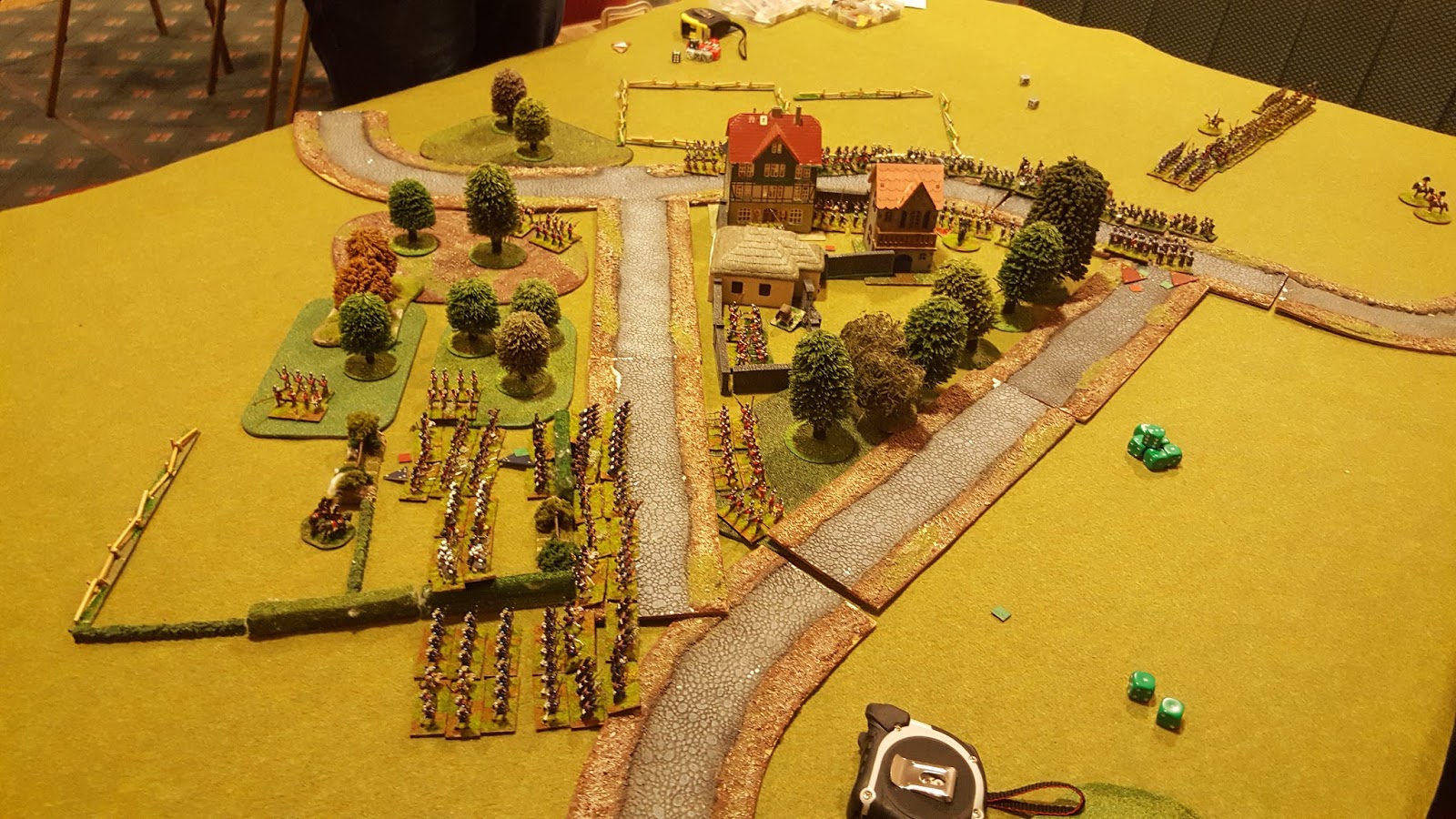
The photos below show the situation as we had to call a close.  The Allied defenders have withdrawn into the chateau, walled enclosure, orchards and formal gardens, although there are some scattered units retiring through the woods.  Opposite the chateau, lining the track, is Bauduin's brigade, with Tissot's brigade in the far distance swinging around to envelope Hougamont from the rear.  In the foreground, Soye's brigade is about to storm the orchard.


Soye's brigade, pretty much intact, although the left most battalions have taken some hits through flanking fire from tiny Nassau infantry batallions in the woods.  A distinct lack of firepower is a disadvantage for tiny units!


Bauduin's brigade facing up against a tiny unit of Nassauers in the chateau and a scratch unit of small Guards infantry batallions in the walled enclosure and orchards.  Bauduin's brigade has lost one battalion that turned and fled.


Bauduin's and Tissot's brigades, Tissot is inching around the angle of the orchard to come against the rear of Hougamont.  Not on table is a battalion of British Guards infantry in the orchard (we didn't put it on as it was the last turn).


Another view of Hougamont from the main British line.


We called it a draw.  The French had 4 turns left in which to take the chateau and felt they had a good chance to do it.  The Allies were nervous, but generally happy with their defensive line.  Tissot's brigade might have had a nasty shock when the final Allied reserves arrived, including a brigade of the KGL and a brigade of Brunswickers, coming on in 2 turns time.

All in all, a good scenario, probably needs a bit longer than an evening to play through to a conclusion.  We were happy with how the table looked, with nice sense of mass to the French brigades as they advanced.

Thanks for looking.

Friday, 4 August 2017

A couple of random games

Two weeks back I played in a Napoleonic Black Powder game in 28mm.  Two British infantry brigades and a cavalry brigade took on two French infantry and one cavalry brigade for ownership of a pub in the centre of the table.  I commanded one infantry brigade and some Dragoons, while Mike took the other brigade and some heavy cavalry.  Ben and Owain took command of the French.

I took these pictures to highlight the English Riflemen on the left flank (a small 6 figure unit) who took on the best part of a brigade of French infantry, including a large unit of Voltigeurs - and won.  They advanced to take up positions on the edge of the wood, shooting up an infantry column in flank.  In response, the French general decided to sweep them aside, but although shaken, the riflemen kept holding on or retiring, before rallying again.  Eventually, they shook and routed the Voltigeurs, which broke the French brigade due to losses elsewhere as well.  This shows the situation near the end of the game where they were swinging around to take another infantry battalion from the flank - tough guys these Riflemen.


Then last week I played a game of Battlegroup Blitzkrieg at a new venue for me, the Wargamestore at Brimstage on the Wirral (http://www.wargamestore.com/).  They have a late gaming night on a Wednesday.

This game, set in 1940, saw the Germans deploy 2 motorized infantry platoons, 2 platoons of Pz 38ts, 1 platoon of Pz IIs and some recce against dug in British infantry supported by cruiser tanks and some Vickers light tanks.

The Germans advance - my infantry and Pz IIs advance on the left, Phils Pz 38ts and infantry advance on the right and centre.


The British tried to use their Vickers tankettes to catch my PzIIs and infantry.  Using a reserve move and their 24 inch speed, they swept through the defences and around the trees, destroying a Panzer II.  The surviving PzIIs tried to take the Brits in the flank and failed to penetrate at all.  The infantry debussed and close assaulted the Vickers tankettes with ATMs, knocking onhe out for no loss.  In the following activation, the Vickers shot up the remaining Pz II and pulled back behind the wood.


By the end of the evening, both sides had taken losses bringing them close to their break limits.  We called it a draw, which was pretty much a victory for the plucky Brits holding the line.


Two very good, fun games, with lots going on.  Sorry the pictures are a bit disjointed and sparse.

Thanks for looking.

Saturday, 23 July 2016

Glory Halleluiah! ACW game

We played out another scenario from "Glory Hallelujah!" at the club last week.  This time it was "Bartlett's Farm - 1863" and we used Will's (Fire at Will) most excellent 20mm ACW collection.  Ian and Will took two Reb brigades each, while I took the greatly outnumbered (but not for long) Union 1st Division.  The idea was that if anyone else wanted to join the game they could take on one of the reserve forces.

The terrain lay out, mainly using club terrain with some of Will's snake rail fencing and buildings.  Rebs come on from the right and need to cross the stream to get to grips with the Union deployed between the road and the stream.  Union reserves come on from the left at a random location determined by dice roll on the roads or through the woods.


The Reb hordes come out of the forest and push towards the stream from the top edge of the photo.  Union defenders are deployed in a thin blue line.  The line is anchored in the centre on a rifle regiment occupying a farm building just out of sight off the bottom of the photo.


A couple of southern gentlemen, Will and Ian.


Well, once we got started, it took three turns to conclude.  The Rebs attempted to rush across the stream and generally managed to fail command rolls, coming on in a piecemeal fashion.  Meanwhile, the Union rolled for each of three brigades to come on, needing 4+, and they succeeded in bringing on a brigade per turn, randomly spread across the back of the Union line.  Will's Rebs did contact the Union line, but finished up with a broken brigade and various whipped units.  The Union front line was similarly shaken but holding firm, for now.  However, behind the Union front line were three fresh brigades deployed in double lines, which the southern gentlemen didn't relish attacking, so decided to slink away into the undergrowth.


Taken from the Union left, the front line shows the pounding it has taken with lots of hit dice and shaken or disordered markers (yellow/red respectively).  The Reb right is in an even poorer state with some regiments routed or whipped and one brigade broken.  The Rebs on their left flank took too long to get through the woods, but were by the end making a nuisance of themselves shooting under cover from the edge of the trees. 


Three very similar shots, highlighting the superb figures from Will's collection, which is most excellent.


We have only played the scenario once, but it seemed to us that there was too good a chance for the Union to bring on reserves.  Three brigades with an evens chance of each coming on means only a 1 in 8 chance of not getting any reserves at all on turn 1.  With the odds in favour of a steady Union build up, if the Rebs don't get to grips with the Union line in the first couple of turns, it will all be over for them very quickly.  It was lots of fun for me as the Union player, but I suspect less so for the southern gentlemen.
 
Looking forward to the next ACW outing, having "seen the elephant".
 
Thanks for looking.

Thursday, 7 July 2016

Gettysburg; Picketts Charge in 10mm

For the second day at Gauntlet, Will and I were debating whether to carry on with the Korsun Pocket game or try an ACW scenario from the new Glory Hallelujah! Black Powder book, which Will has recently acquired.  On hearing this, Steve mentioned he had a 10mm ACW collection with 30+ regiments per side.  This was too good an opportunity for Will to organise a refight of the Gettysburg - It can't be long now scenario.  Terrain was a simple ridge along one long table edge, lined by Union infantry and artillery, with the Rebs arrayed up to 1ft on from the opposite table edge.  For the Union, Gary took the let wing with II (part) and III corps, Jamie the centre with II corps 2nd Division and I corps 3rd Division, and Richard the right wing II corps 3rd Division and I corps 2nd Division in reserve.  Opposite them on the Rebel right was Steve with Pickett's Division and on the left was me with Pettigrew's Division with Gary and Trimble's Division behind me.

So, it's July 3rd 1863.  After 2 days of heavy fighting around the Pennsylvanian town of Gettysburg, the armies of the Union and Confederacy face off against each other, the Union occupying Cemetery Ridge and the Confederacy occupying Seminary Ridge.  Lee appears to have reached a decision and ordered Pickett, Pettigrew and Trimble to assault the Union lines.  The scenario starts with the Rebs approaching the Emmitsburg Road and about to have a very bad day.


Trimble's Division in the foreground with Pettigrew's Division beyond.


Pickett's Division nearest the camera.


The Union defence in depth on the ridge.


Looking from Cemetery Ridge towards the Emmitsburg Road.


The first turn sees Pettigrew get all 3 of his brigades moving forwards, while Trimble gets one brigade to advance, the other deciding to wait a bit to see what happens.


On the right, Pickett's men are positively jogging.  However, rather than focussing on the same point in the Union lines as Trimble and Pettigrew, they are veering off towards the Union left wing.


The view at ground level.


Pettigrew's troops with Pickett charging in the distance.


Pettigrew starts to shake his columns out into 2 regiment deep lines ready to charge home on the Union lines.


Pickett continues to advance, but not quickly enough.


Pickett is now within charging distance of the Union line.


Pickett's other brigade picks up the pace.


Pettigrew stalls momentarily.


Trimble gets a rush of blood and moves up on Pettigrew's flank.


One of Pettigrew's brigades seems to have developed a death wish.  Union commanders look on expectantly.


Lunchtime, and I had to take some photos of the excellent Team Yankee game organised by Dennis and Pete.  The crashed cars in the town centre look great.


Love the American SPG models.


Apache gunships move in on a company of T-72s.


After lunch, back to Gettysburg.  Pettigrew's Division charges the Union line.  Despite withering closing fire, they manage to wipe out 2 Union batteries and melees embroil the length of 6 regiments.


The view from the ground.


Trimble's brigades move up and the foremost brigade gets within musket range of the Union flank.


Ongoing melees sap the strength of attackers and defenders.


Confederate ranks are thinning faster than the Union at Pickett's end of the table.


Union numbers on their left flank told in  the final analysis and 2 of Pickett's Brigades broke and fled the battle.  We played out another turn at Pettigrew's and Trimble's end of the table as there were a number of ongoing melees, which were often going the Reb way, although fresh reserves were being fed along the line, so it was only a matter of time.  Trimble's Division was able to retire largely unharmed, while Pettigrew's Division was badly mauled and Pickett was down to one effective brigade.  I think this is one of those scenarios where the Rebs can only win by not turning up.  The High Water Mark of the Confederacy was a little further north of the actual historical spot, but about the same distance in, which suggested an honourable draw, albeit a very bloody one for the Rebs.

Thanks to Steve for providing the troops and terrain and for Will for organising the scenario with very little lead time.  Thanks also to Gary, Jamie, Richard C, Steve and Gary for providing a fun game with the right level of commitment to the scenario tasks, the history of the period and, above all, having fun with toy soldier.

Thanks for looking.

Tuesday, 11 August 2015

Ligny at Gauntlet 2015

Having been involved in a 15mm game based on Quatre Bras on the Saturday, it seemed appropriate to join in the big Ligny game organised by Will on the Sunday ( http://willwarweb.blogspot.co.uk/2015/07/first-pictures-from-gauntlet-ligny.html and http://willwarweb.blogspot.co.uk/2015/07/gauntlet-ligny-part-2.html ).  This was a spectacular game laid on using Will's extensive Napoleonics collection in 20mm, mainly using plastic figures collected over a lifetime.  For the second day of fighting, I joined the Prussian high command, bringing the number of players to three, versus four French players, including one representing Napoleon.

Looking southeast past Wegnelee towards St Amand.  Prussian forces have crossed the brook and taken position of various hamlets, which are the centre of fierce assaults and the exchange of surprisingly ineffective volleys.


Napoleon, in conversation with the umpire (Will), actually rolling to see if the Old Guard are available this turn; alas not this time.
 

Ligny in the distance, held by Prussian infantry and being assaulted by French infantry.  At this time, French artillery is counterbattery firing on Prussian artillery, so is not available to reduce the buildings.


The Prussians have assembled a Grande Battery of their own, opposite St Amand, although this failed to be as effective as the French artillery concentrations.  In the angle of the brook between St Amand and Ligny, French young guard cross the brook in an attempt to storm the Prussian centre.  Moving to meet them a thin blue line of Landwehr and Line infantry (my command on day 2).


The great cavalry stand-off beyond Ligny - neither side can cross the brook without taking severe punishment.


The left flank of the Young Guard get strung out and disordered while crossing the brook and then face volleys from the Prussian infantry.


The Prussian infantry initiative charge home into the left flank unit of the Young Guard and, against all expectations, the guard disintegrates and flees the field, sweeping away their supporting battalion in the rout as well.  Unfortunately, although I can't complain, the remaining guard units stand firm. 


The remnants of the Young Guard and Prussian infantry exchange volleys, in the background the drums are beating and the Old Guard is on the march.


Concentrated battery fire from the French artillery eventually pushed the Prussians out of Ligny, one city block at a time, although one unit hangs on in the centre of the city.

 
 The French make little headway in the fight for St Amand and the other hamlets.
.

Prussian and French infantry looking a little shaken, although fresh Prussians on the left start to swing the balance locally?


There the game ended.  Lots of fun and another of Wills great spectacles.  A big thank you to Will for organising it and furnishing all the models and terrain, to the Prussians for letting me play with some of their command and to the French for being such good opponents.

Thanks for looking.