Translate

Friday, 24 September 2021

20mm WW2 German winter Fallschirmjager

 I've had these in the completed pile for some time, but needed to add magnetic bases to get them stored away.  Having done that, it was time for some photos.  These are from the recent Mars set and provide a selection of Fallschirmjager in padded winter clothing.  I've based them in the standard late war organisation with three rows of 5 man rifle groups (rear right) and three MG34 teams of three men rear left.  The front row is a command rifle section of 6 men including the CO, plus a 2 man panzershrek team (front left) with an old Airfix figure with arm in sling as a No 2 gunner.


Most are painted in variations of white or mid-grey to reflect their winter patterns, with the off figure in a Luftwaffe camo smock of beige, green and brown.


Close up of the CO and radio operator.  Odd pose with the pistol pointed into the air, perhaps he is signaling with a flare gun.


Each rifle and command section is also equipped with a panzerfaust for local AT defence.


Quite nicely animated figures from Mars, with some annoying, but manageable pieces of flash, mainly close to faces and ankles.  The figures hunched and leaning into their shots look nice and lively, as does the figure leaning into a trot with rifle across his hips.

Thanks for looking.

Wednesday, 15 September 2021

20mm WW2 US paratrooper supply carts

I picked up a little bag of SHQ figures from the tabletop sale at Penkridge back in August.  Four supply carts and 4 2 man crews.  Two were standard supply carts, while the others were supplied with models of lieutenant colonel Benjamin Vandervoort - not sure what I'll do with the spare Vandervoort.  The cart crews include a standard US infantryman, but I've painted him up as a paratrooper - he just hasn't bothered to camo up his helmet and add some skrim.


For D-day, these guys are painted in green ochre, with added US dark green reinforcing patches on knees and elbows.  Webbing and equipment is German camo beige, while helmets and carts are brown violet.  Weapons and wheels are black grey.

Vandervoort carts. 


Basic supply carts.


Nice little bargain set to add some resupply capability to my US paratroopers.

Thanks for looking.

Saturday, 11 September 2021

20mm WW2 German artillery support

Some on table artillery support for my late war Germans.  A pair of 105mm Howitzers, guns are from Zvezda, crew are Britannia/Grubby in camo smocks.  Guns are basecoated in middlestone lightened with Iraqi Sand, green stripes/blebs are Luftwaffe camo green with German Field grey to tone down the green, and armour brown, lightened with mid-brown.  All washed with Agrax Earthshade and dry brushed with Iraqi Sand.  Uniforms are cork brown with Luftwaffe camo green splodges, dotted with German camo light green.  Boots, webbing and metal equipment is black-grey.


Gun No 1.


Gun No 2.


Then a 150mm Sig 33 infantry gun and crew from Britannia/Grubby, painted the same way as the 105s.


I've also been working on some US paratrooper supply carts and I've still to photograph the winter Fallschirmjager platoon.  Still to come off the workbench are an Airfix 88m with SdkFz 8 tractor and more APCs for 21st Panzer.

Thanks for looking. 

Monday, 30 August 2021

More 7th Cavalry action

Saturday saw a day's gaming session at Beacon Gaming Club.  Si had laid on a game using his Britannia Miniatures Cavalry and Indians figures, so I joined Will and Gary in the game, as Colonel Sheridan officer commanding Fort Laramie.

Sheridan was expecting a supply column from the northeast, when word reached the fort from a nearby trading post to the east that a party of settlers was in trouble along with their troop of escorts.  At the same time, pressure was on from HQ to support the local Cheyenne chief, who was still following a peaceable existence while younger hot heads were on the warpath.

Hastily writing orders, I sent a young officer off with two troops of dismounted cavalry to try and rendezvous with the supply column at a nearby water hole.  I sent another 2 troops of cavalry to the east to rescue the settlers and guide them back to the fort.  Leaving my third officer in the fort with the infantry, I rode with three troops towards the old chief's camp to provide some protection.

Sheridan leads the first troop out of the fort.


Infantry defending the fort.


The settlers with their defence troop, harried by hostiles.


Guided by smoke and gunfire, the two troop flying column shows up just as the hostiles melt away.  The escort troop and one of the relief troops head back to the fort, while one of the troops heads towards the trading post to swing around to the south to strengthen Sheridan at the village.


Meanwhile, the two dismounted cavalry troops trying to rendezvous with the supply column are bounced by a massed horde of mounted savages.


The two parties of dismounted troopers prepare to sell their lives dearly.


9

The first undisciplined rush strikes home.


And bounces off, but more rush in.


The forward troop began to give ground, falling back to join the other troop, while repulsing multiple charges.


Broken units heading for home.


No sooner had that action ended, when Sheridans command of three troops met twice as many hostile war bands at the old chiefs camp.


Sheridan ordered two troops to mount and charge the hostiles, while the third stood form by the water hole.


The melee heats up at the camp.


The cavalry charge and charge again.

The boys from the trading post arrive and pitch in to the hostiles from behind.


Sadly, the dismounted troopers couldn't withstand the onslaught from front and both flanks, the survivors fleeing.


Sheridan's men had done enough though, saving some of the settlers, resupplying the fort and rescuing the peaceful native factions, thus buying some time before the next wave of unrest.

Apart from my strategic movement choices, I had little to do to influence the individual combats.  The hostiles won almost all initiative roles and chose to charge, so the combat results were driven by a single d6 roll.  We were amazed at Will's ability to roll 1s (not good), with almost nothing greater than a natural 3, resulting in repulse after repulse.

This was a fun game to play and the mechanics would lend itself to other colonial periods, such as the Foreign Legion in N Africa or Mexico, Colonial Africa, Russian Civil War, etc.

Thanks to Si for setting it up and providing the troops and terrain, Gary and Will for playing alongside, especially Will for rolling dice all day despite some horrendous modifiers.  Thanks to you for looking.

Sunday, 22 August 2021

Blockhouse Park, Plymouth

Close to my old home in Plymouth is Blockhouse Park.  I was familiar with the layout of the old fortification visible today, but had no idea of what they represented until a recent visit, when I saw these new, to me anyway, information boards.

Described as a small artillery emplacement built in 1780 (1779 on internet) as an outer defence for Devonport Dockyard, modified in 1811 and obsolete by 1840.


The outer works, now an earthen ditch and bank, originally revetted in stone.


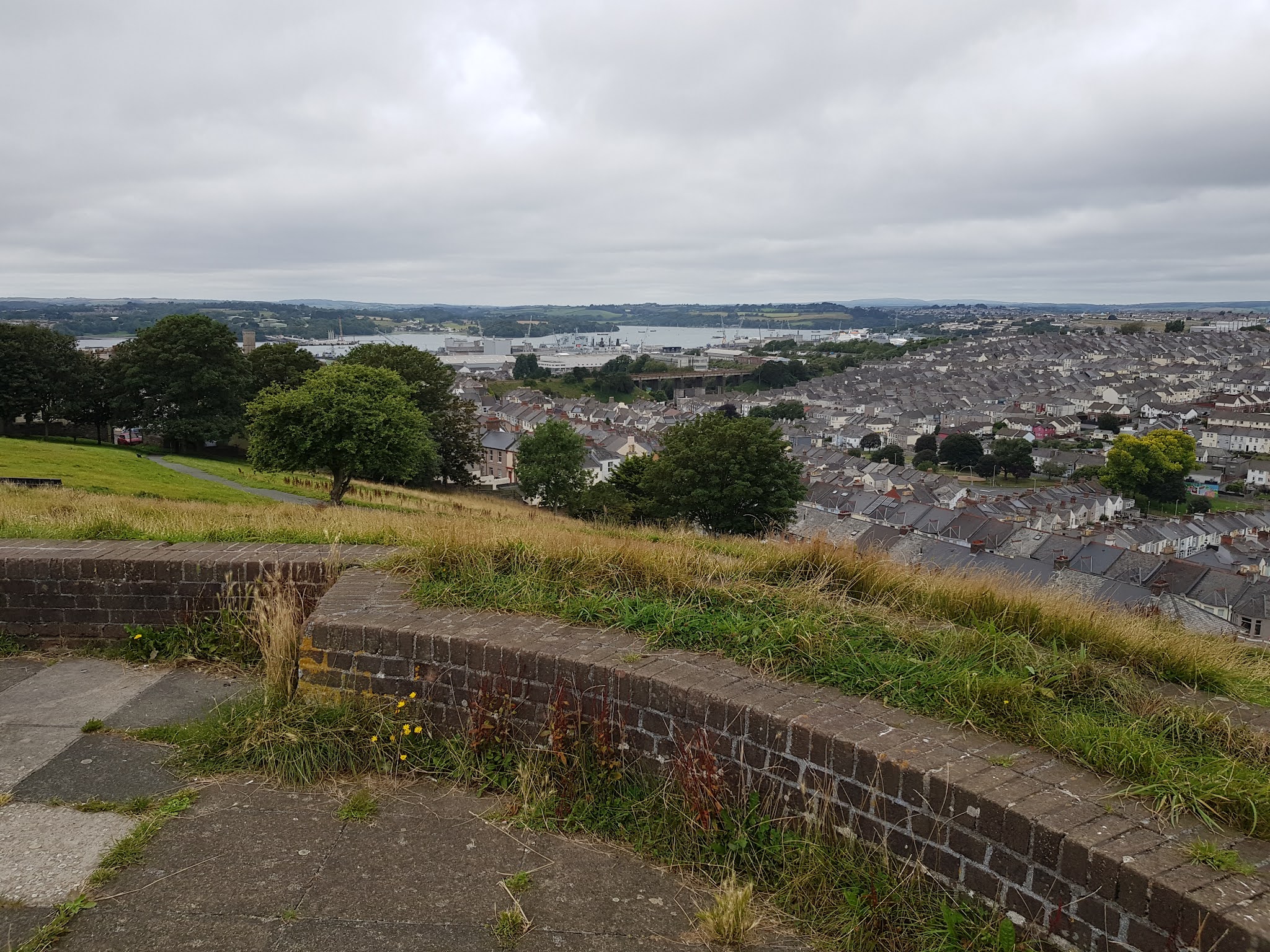
The view from the outer ramparts looking northwest towards the dockyard.  The fortification lies on the highest point within the city and dominates the ancient route into the city from the north, the only route not protected by deeply incised valleys floored by tidal estuaries prior to the start of the 20th Century.


The interior of the outer works.  The old earthworks were improved with brick in the 1930s in preparation for use as an anti-aircraft, searchlight and Barrage balloon site in WW2.


The western rampart.


Looking across the interior of the fort to the north, the topography is markedly less incised than the deep valleys to northwest and southeast.


Information board within the fort, showing the likely blockhouse construction within.  Probably a stone built blockhouse at ground level, with a wooden first floor.  Contemporary with similar structures built throughout North America during the French-Indian (7 Years War) and Revolutionary (American War of Independence) Wars.


Another information board showing a reconstruction of the whole site as originally built.

This was an unexpected plus, resulting from us looking for a good site to view a firework display.  As a family, we knew about the use of the site in WW2 and that it had an older history, but no idea of the 18th Cent origins and the contemporary nature of the defences with those built in North America.

Thanks for looking.